
The Konfidence Course
For parents who split time with their kids
Help your kid speak up, try hard things, and bounce back from failure, starting with the example you set.
A practical, parent-first course for raising outrageously Konfident kids.
Form not loading? Tap here to join the waitlist.
Raises their hand. Asks the question. Says what they actually think instead of what they think everyone wants to hear.
Tries out for the team. Introduces themselves. Goes after things they’re excited about, even when there’s a chance they’ll fail.
Doesn’t make the team. Gets rejected. Makes a mistake. And tries again instead of deciding they’re not good enough.
Konfidence isn’t believing you’ll always succeed. It’s trusting yourself enough to try.
“The heaviest burden a parent can give a child is the unlived life of the parent.”
Carl Jung
In the Konfidence Course, you’ll give yourself permission to quit putting your life on pause. The best thing you can do for your kid is learn to trust yourself again and build the biggest life possible. I’m going to show you how.
When researchers study anxious kids, the same three things keep showing up. They overestimate danger, underestimate themselves, and talk down to themselves. For me, none of it was ever louder than when my home life blew up. I got more anxious and more self-critical. Then I saw it in my kids.
You: don’t go for the things you know you should.
Your kid: holds back because they’re scared, not because they can’t.
You: play smaller than you could.
Your kid: shrinks in groups when you know they can shine.
You: second-guess what you said after you said it.
Your kid: talks down to themselves out loud.
Kids of anxious parents are up to seven times more likely to develop anxiety themselves.
When parents change, kids change with them. That’s why you’re going to focus on the only thing you can really control: you, and the environment you create.
Your kid says, “I can’t do it.” You tell them how amazing they are.
You help them break it into something they can try, and let them discover what they’re capable of.
Your kid fails at something and wants to quit. You rush to make them feel better.
You help them separate the outcome from who they are, learn from it, and decide what to try next.
Your kid is scared to speak up. You speak for them.
You help them prepare, then give them the space to use their own voice.
I started doing one-on-one clarity calls with parents who were worried about their kids. The same pattern kept showing up: a kid who talks down to themselves, stops going for the things they want, and treats every failure like a verdict.
The longer I talked with the parents, the more I heard the same things in them. They’d stopped going after the goals they really wanted. Failure scared them as much as it scared their kids.
So we worked on the parent first. They started having different conversations with their kids, and things at home started to change.
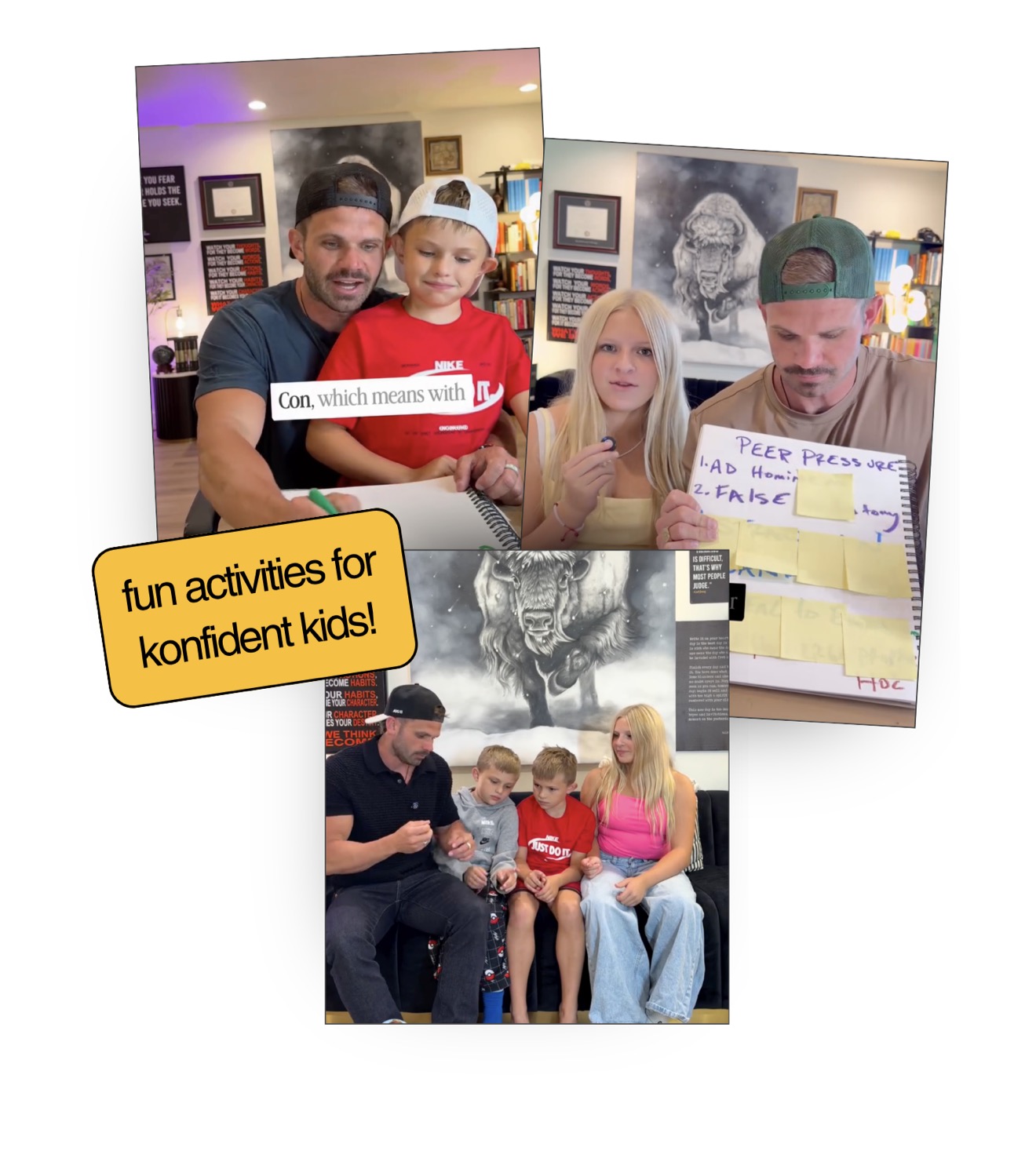
But not every parent can spend a few thousand dollars on one-on-one coaching. So I built the Konfidence Course: the same principles I use with parents, plus a distilled version of every exercise for your kid.
The goal: every time your kid leaves your house, for school, sports or time with a co-parent, they leave with a little more trust in themselves. They go into the world with a little more Konfidence.
I asked my audience: if I was building a confidence course, what would the biggest win be? The answers were astounding. A lot of people had divorce-specific questions — so I wanted to give that answer in this course.
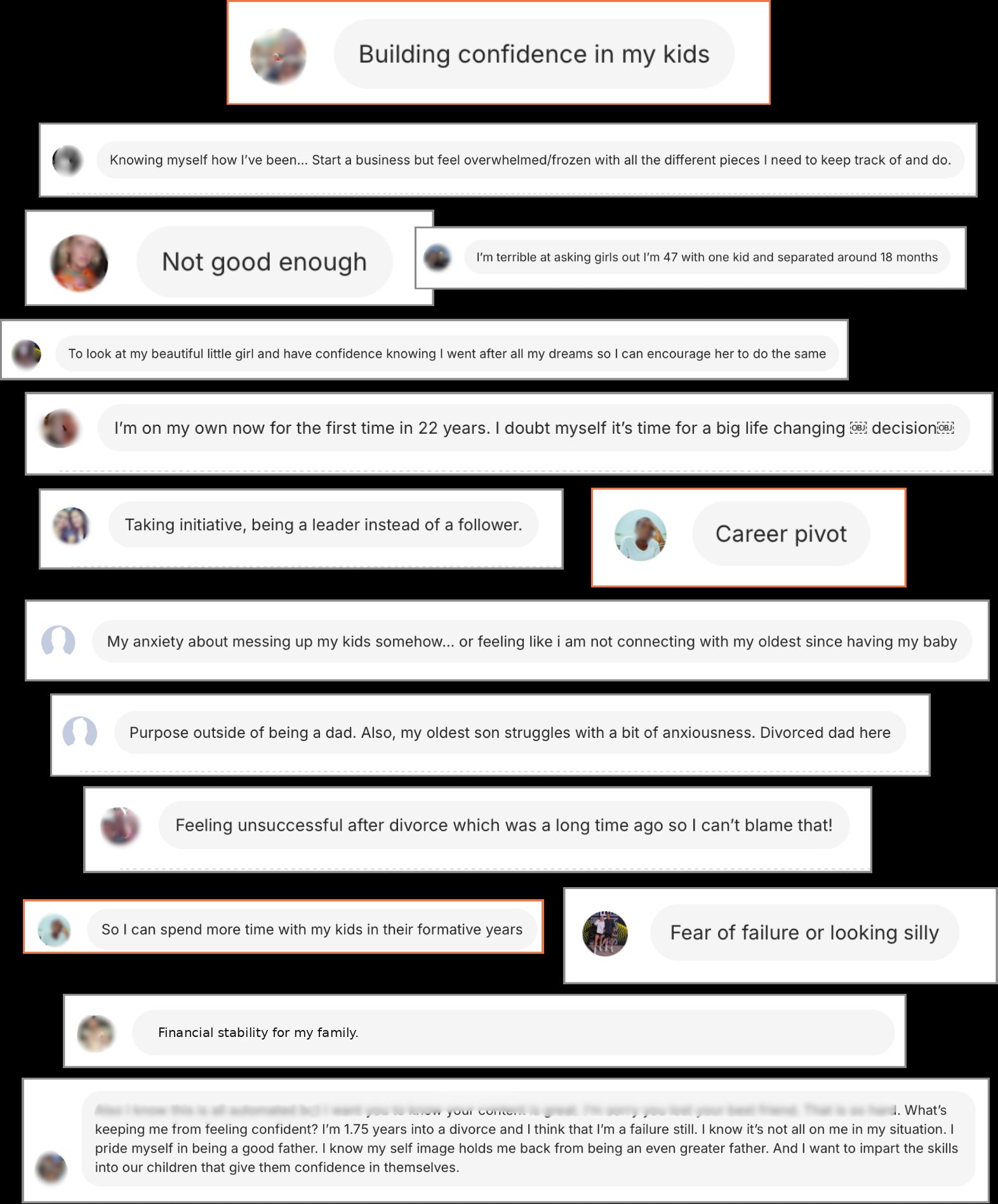
These are replies from parents like you. If one of these sounds like you, this was built for you.
By the end of the course, you’ll have:
Confidence built on someone else’s goals doesn’t last. Inside: how to listen to your heart again, and how to know your value so you never trade it.
You can’t be confident while a voice in your head calls you stupid all day. Inside: how to find your inner critic and kill it, and the nightly routine that ends negative self-talk.
Comfort and comparison quietly drain your confidence. Inside: how to build an alter ego that does the brave thing when you’d rather shrink, for you and your kid.
Find the zone where practice feels good enough that you don’t want to stop. Inside: how to get lost in the work, how to turn every failure into feedback, and the power of “yet.”
Guilt pushes most of us into protecting too much, or overcorrecting with pressure — especially when you only have them part of the week. Inside: how to hold high standards with high support, how to garden instead of sculpt, the words that become your kid’s inner voice, a family creed your kids can recite, a bedtime ritual that ends the day on a win, and the exact words for the hard moments.
Also inside: a parent/child workbook for every module, and Konfidence Conversations, interviews with experts added to the course over time.
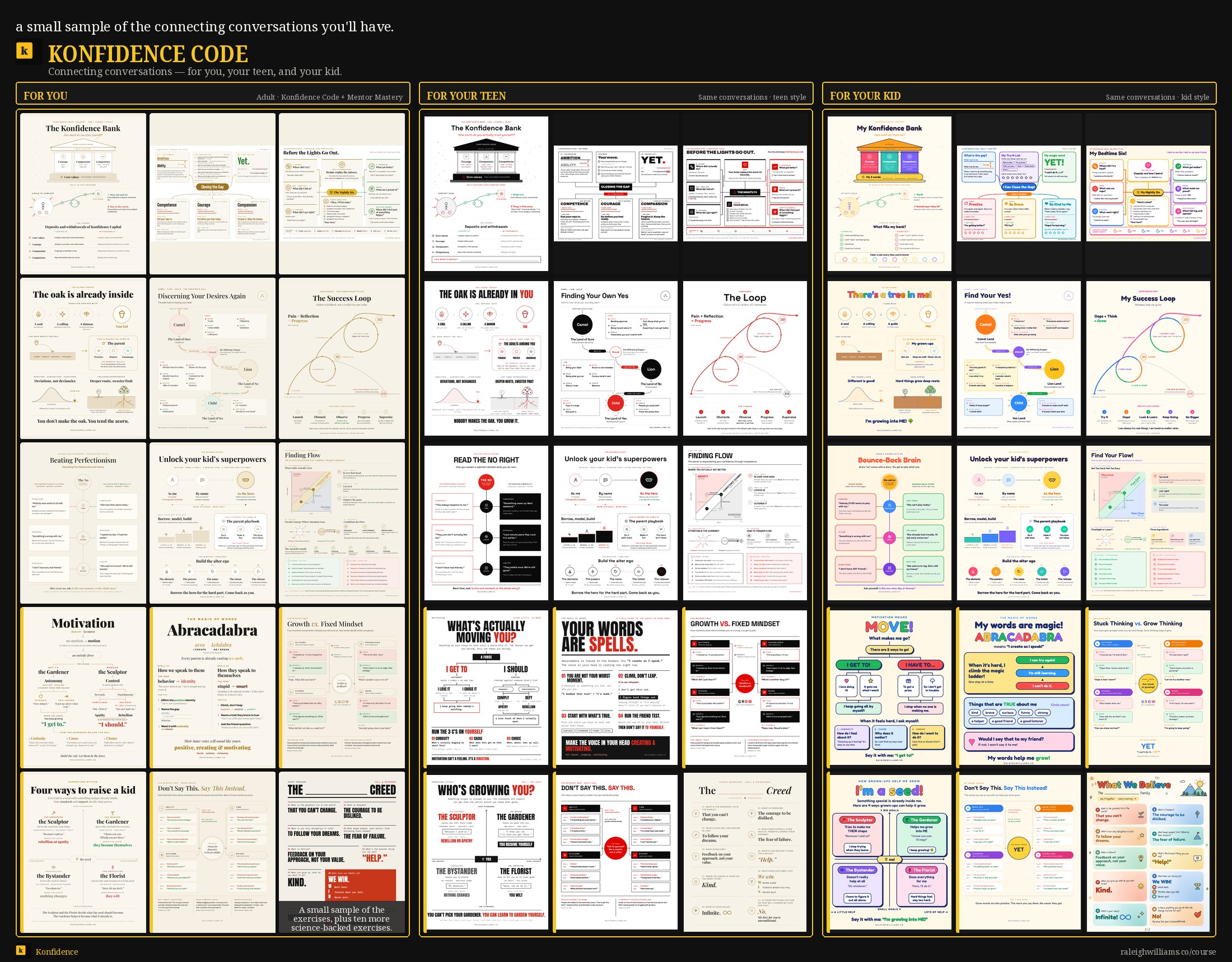
A small sample of the connecting conversations you'll have, with teen and kid versions of each.

You can’t give your kid confidence. But you sure as hell can show them what it looks like. Two things: an environment where confidence flourishes, and a parent they watch go after a dream, fall, and get back up. That’s what this course builds.
Your kid might roll their eyes the first time. You might feel silly doing the exercises yourself. Good. That’s the part that works.
I can’t hand you a copy-and-paste template, because confidence doesn’t work that way. Some exercises will land for your family and some won’t. That trial and error is how you find what actually works for yours.
No course will make anyone fearless. This one will give you both proof you can do hard things, and a way to keep collecting it long after you finish.

I was a painfully shy kid who couldn’t say my R’s until sixth grade. Today I have more than 300K people following my advice on parenting and confidence.
I’m a former lawyer and entrepreneur, but most importantly, I’m a concerned dad who went through a pretty tough divorce and was worried about how it was affecting my kids.
Thanks to my law background, I can read thousands of pages of research and turn them into actionable, easy-to-remember frameworks. So that’s what I started to do. I devoured everything I could find on confidence, and the picture surprised me.
The issues I saw my kids struggling with were things I was struggling with too. During my divorce, I quit putting myself out there. I quit trusting my inner voice. I traded my dreams for survival, and I didn’t know a way out.
When I realized that becoming a shell of myself was hurting my kids, I started to snap out of it. I shared a bit of that journey online, and it resonated.
Now my relationship with my kids is better than it’s ever been, even before the divorce. They watch me try new things, fail, keep going and find success every day. It didn’t get better because I got everything right. It got better when I started working on myself and refused to settle for surviving for the rest of my life.
Finding Konfidence saved my life. It can change yours in ways you can’t imagine yet.
Konfidence isn’t a mindset. It’s a learnable skill set. And like every skill set, it gets better when you work at it.

If you see at least three of these in yourself or your kid, it is.
The waitlist gets in first, and the first 100 members get founding pricing. Join the list and you’ll hear before anyone else.
The Kickstart is a quick start for you: a first taste of the parent-first approach. The course is the full system: all five shifts, step by step, with a kid-friendly way to bring every lesson home.
You don’t need them to be. Everything in the course is about what you model and what you say during your time. Your kids will notice the difference, whatever happens at the other house.
Short answer: yes. Everything here applies to married parents too. Divorced parents are up against a particular set of challenges, and I wanted to address those head on.
Yes. The principles of Konfidence work whether you have kids or not. And the Mentor Mastery section works for anyone in a position of authority: managers, coaches, leaders. It shows you how to spark self-motivation in the people you lead and use your authority for good.
The kid conversations work best from about 7 and up. My twins are 8, and they understand most of it and enjoy it. With a kid under 5, the lessons are still for you, and that’s where most of the impact is anyway. Little kids learn what confidence looks like by watching you do it.
Five to ten minutes per lesson, at your own pace. Do the parent work on your weeks without them. Bring the kid conversations home on the weeks they’re with you.
Everything lives in Circle. It’s self-paced, so you start when you join and go at your own speed.
No. It’s skill-building, not treatment. If you or your kid are dealing with anxiety or depression that’s getting in the way of daily life, please talk to a professional. This can sit alongside that, not replace it.
Someday your kid will have to raise their hand, approach someone new, face rejection, or take a chance without you standing beside them. You won’t be able to make the decision for them.
But you can help shape the voice they’ll hear when that moment comes. A voice that says:
I’ve done hard things before. I can figure this out. And even if I fail, I’ll be okay.
That’s Konfidence. And it starts with you. Join the waitlist. The first 100 members get founding pricing.
Form not loading? Tap here to join the waitlist.